

Finding the perfect piece of art for your space can be a true ‘eureka’ moment: suddenly, everything comes into focus, starts feeling entirely right.
Art has been livening up our homes since at least the Neanderthals, Spain’s version jazzing up their Maltravieso cave some 64,000 years ago with hand stencils – but though paintings and prints remain classics, sometimes we want something a little harder, sharper, more real.
Enter photography, which pairs with other art, of course – in the same way pretty florals and hard-edged concrete work brilliantly in a Brutalist building – but on its own gives an almost documentary-style immediacy, no matter how abstract it might be.
Bristol-based photographer Barry Cawston RWA is someone I’ve worked with before, and suspect will keep going back to: you only need to glance at his work to see why.
“I’ve always been interested in photography,” Barry says, “but only realised its wider artistic potential when I went to an exhibition of photographs by Zygmunt Bauman, a Polish-British sociology lecturer at the University of Leeds, where I studied.
“His lectures were rammed with students from every department, and when I saw his exhibition I realised he was saying the same things in an image as he was in the classroom. I was inspired to a new understanding of the potential of the medium, staying in Leeds to do a photographic course, and a pathway was set.”
Barry likes to say that he ‘finds’ each piece, rather than designs it. “My work’s often been likened to painting, especially for its sense of colour, but there’s an added element, too: the idea of a ‘magical moment’ in the real world that first captured my eye, then hopefully does the same to anyone seeing the resulting photograph. Some pictures I call a ‘given’: I just happened to be in the right place at the right time.
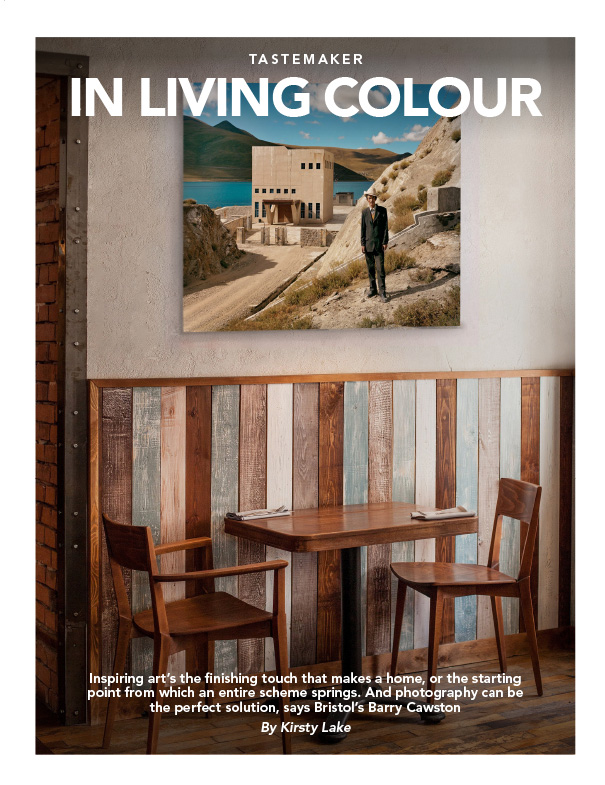
“The Tibetan Cowboy is a good example of this. When I took it, I knew it was special, and I’ve since entered it into four competitions, and it won them all. It will probably be the best picture I’ll ever take; there’s something surreal about it and, as it was taken on a large format camera, a print at four or five feet across looks amazing.
“For many years, in fact, I only shot large format, and would rarely take more than four or five pictures a day, so each image had to be special, summing up an idea or an emotional response in an almost meditative way.”
Photography’s far from new, it’s been around since the early 1800s, but is still considered a very contemporary medium, and in most homes, especially with sympathetic framing, can add a modern edge to a space.
Certain patterns start to develop, perhaps subconsciously: many images feature just two main complementary colours, for instance, which makes it easy for prospective owners to see how it might work in a specific space. Indeed, sometimes an interior designer might bring Barry in early; he gets to see what the space to be filled looks like, then will go through his archive and suggest pieces that might fit.
Some images work anywhere, and sell quickly and easily, but Barry’s often happiest when one of his more esoteric or oddball photographs works for a person or space.
“There was one picture I took of the outside of an artists’ studio in Brooklyn, New York,” he says. “The artists had poured their spare paint down the brick wall and it felt like finding a rainbow on the street. I printed it at 250cm wide, mounted it behind acrylic, and it was hung on the red brick garden wall of a conservatory in a large house in Richmond, London. It featured in the World of Interiors.”
Of course, impressing World of Interiors, or anyone else, should hardly be your first motive when picking a piece of art; you should love it, and be confident you can live with it.
“I’m not just a creator,” Barry says, “but a customer too, so I’ve bought plenty of pieces of art myself, and I’m always amazed by how they don’t just change the feeling of a room, but of the whole house. Right now, in Bristol, I’m especially loving the work of Hammer Chen, a brilliant printmaker, and Dorcas Casey and Peggy Atherton, both wonderful sculptors.”
COLOUR OF MAGIC
The big thing about Barry’s work is how painterly it is, while still being clearly photographic. Though his focus veers from architecture to portraits, landscapes to social documentary, some things remain: bold yet complementary colours; strong patterns and elements of repetition; a potent mix of the contemporary with the classical.
Barry’s work comes in increasingly ambitious and extensive series, and has earned growing attention: not least his Are We There Yet? project based on a day trip to Banksy’s Dismaland. He’s won numerous awards, including the President’s Award at the RWA Open Photography Exhibition, and enjoyed numerous high profile exhibitions, including one at the Capital Culture Gallery during Art Miami in 2023.
Image Credits: See published article
Magazine Published by Media Clash, Bristol Life
https://issue.com/mediaclash/docs/brl380.final